.png)
My SharpMate Stone Isn’t Flat. Is This a Problem?Updated 7 months ago
If you’ve checked your SharpMate stone and noticed a small deviation, felt that your chisel isn’t making full contact with the stone, or ended up with uneven sharpening on your first pass—you’re not alone. These are some of the most common questions we receive.
In most cases, this isn’t a defect and won’t affect sharpening performance when the stone is used correctly. Here’s what’s actually going on.
🔍 First: What “Flat” Really Means for Sharpening Stones
No sharpening stone is perfectly flat at a microscopic level, not even premium stones used by professional woodworkers.
What matters is whether the deviation affects sharpening performance.
Through extensive testing and real-world use, we’ve confirmed that:
A stone with up to 0.05 mm (0.002") deviation in thickness sharpens accurately and consistently when used correctly.
This specification is guaranteed by our manufacturer and validated through hands-on testing.
🧪 Tested & Verified by Rich (Our Woodworker & Engineer)
Rich tested multiple SharpMate stones with varying measured deviations, including:
Stones with deviations as low as 0.02 mm
Stones with deviations up to 0.05 mm
Other stones with even larger deviations
Every stone successfully sharpened a chisel blade, producing consistent, usable edges—as long as proper technique was used.
✋ The Most Important Part: Holding the Chisel Correctly on the Sharpmate
Before You Start: Proper Chisel Height & Thumbscrew Pressure
Before sharpening, the chisel should be installed at the correct height in the holder.
When properly installed, the chisel should just barely make contact with the stone once the thumbscrews are tightened. The thumbscrews are only meant to secure the blade in position—not to apply sharpening pressure.
If the chisel is set too low in the holder, tightening the thumbscrews will force the blade down into the stone. This can:
Make the chisel difficult to move across the stone
Cause excessive wear or gouging of the stone
Lead users to think the stone is defective or not flat
All sharpening pressure should come from your fingers during the stroke, not from the thumbscrews.
Hand Position & Pressure
How you hold the chisel matters just as much as the stone itself.
The SharpMate is designed to be used with two hands guiding the blade, allowing you to apply light, adjustable pressure during the stroke. This ensures consistent contact with the stone—even if there is minor variation in stone thickness.
Here’s the recommended grip:
Wrap both hands around the blade holder
Hook your thumbs behind the holder to push it forward across the stone
Place your index fingers directly on the blade, close to where it contacts the stone
For wider blades (such as plane irons), use both the index and middle fingers on the blade
This finger placement lets you press the blade down gently and evenly, keeping it in contact with the stone throughout the sharpening stroke.
Without this pressure, the blade can lift slightly at the start or end of the stroke. When that happens, it can feel like the stone isn’t flat—even though the stone is within specification and working as intended.
🎥 Watch: Proper Hand Position on SharpMate https://www.youtube.com/shorts/IJE07Ohhoyo
About “Full-Length Strokes”
Some users worry when the blade doesn’t stay in contact with the stone for the entire length of the stroke. This is normal and expected.
A stone at the upper end of our allowed deviation (≤ 0.05 mm) will still sharpen or hone a chisel correctly when used with proper technique.
The image below shows the 400-grit side of a 400/1000 stone installed in a SharpMate unit. This stone measures 0.049 mm deviation in thickness, placing it just inside our specification limit.
This is the same stone Rich has used regularly for several months during testing and video demonstrations. It does not appear heavily worn because it has been used with controlled pressure and cleaned after each sharpening session.
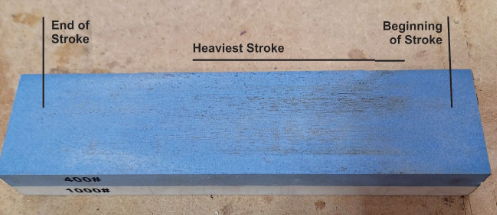
Even at this deviation, the wear pattern on the stone clearly shows consistent contact through the working portion of the stroke.
It’s important to note that some users may interpret this as not being a “full stroke” because the blade does not contact the stone from edge to edge. In practice, however, this is exactly how sharpening occurs in real use.
During sharpening:
The heaviest contact happens through the middle of the stroke
Contact naturally tapers off before reaching both ends of the stone
This is consistent with how experienced woodworkers sharpen, both in professional shops and in widely available instructional content
What matters isn’t touching every millimeter of the stone, but maintaining steady, controlled contact where the blade is actually being worked.
📏 I Measured My Stone and It’s Not Flat. What Should I Do?
If you measured your stone and found a small amount of deviation, here’s how to interpret it.
If the deviation is under 0.05 mm, the stone is within specification and not defective. In this case, uneven sharpening is almost always related to technique—most commonly finger pressure and how the blade is being guided across the stone.
If the deviation is over 0.05 mm, that’s outside our guaranteed tolerance. Please contact our support team, and we’ll take care of it.
Still Need Help?
If you’ve confirmed your stone is outside the 0.05 mm tolerance, or you’re unsure how to measure it properly, reach out to our support team by sending an email to [email protected]. We’re happy to help you get reliable, repeatable sharpening results.